


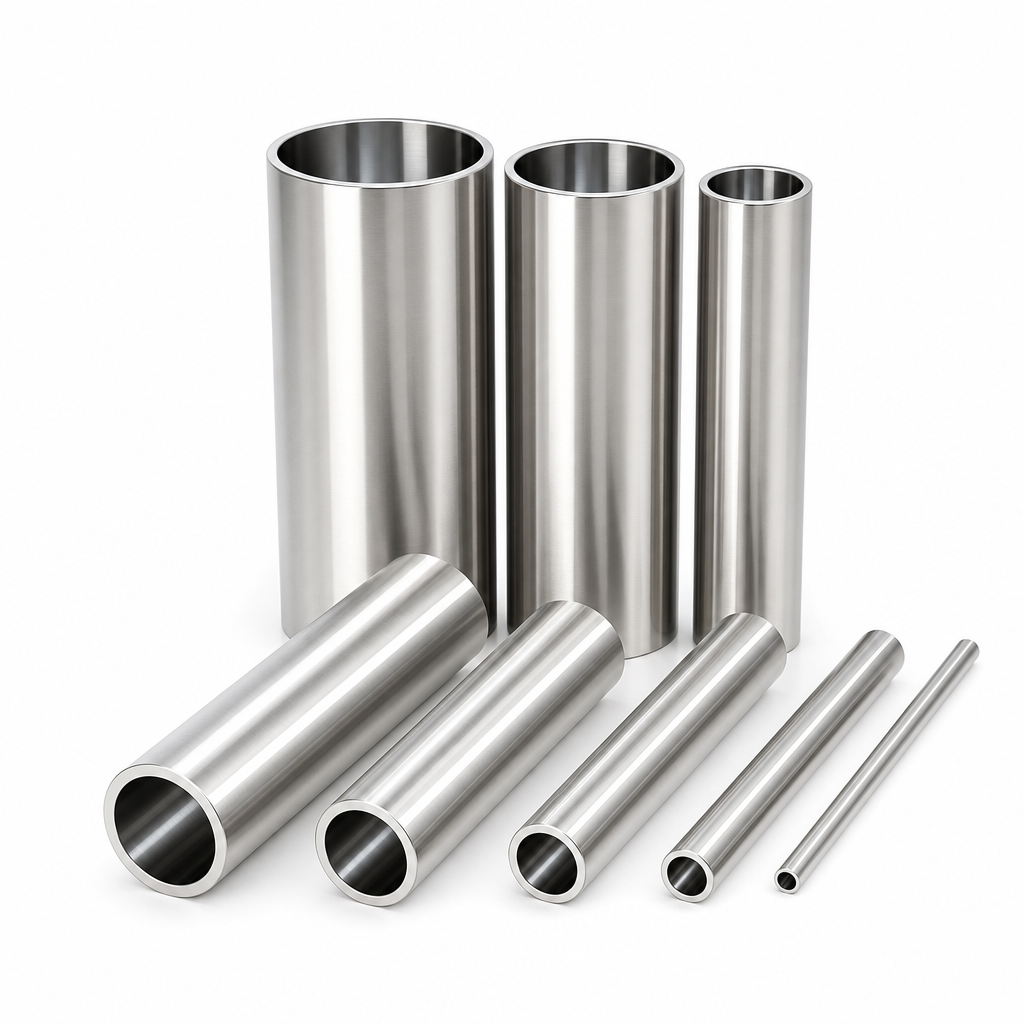
Sanitary Tubing ASTM A270 and DIN 11850 Stainless Steel
Sanitary Tubing ASTM A270 and DIN 11850 Stainless Steel 304 and 316L for Hygienic Process Piping
Sanitary tubing is the part of a hygienic line that carries the product, and it is judged by what you cannot see from the outside. The outside diameter and wall thickness decide whether the tube actually fits every clamp, union, valve and pump you connect to it. The internal surface finish decides how quickly and how reliably the line cleans, and it is the one figure a hygiene auditor will ask you to prove. We supply sanitary tubing to ASTM A270 and DIN 11850 in 304 and 316L stainless steel, from 1/2 inch to 12 inch, in 20 foot and 6 metre lengths, with mill test certificates traceable to every heat.
What the Standards Actually Fix
ASTM A270 and DIN 11850 are not interchangeable documents, and mixing them is the most common cause of a line that will not assemble. A270 is the US hygienic tubing standard and works with inch based clamp and union systems. DIN 11850 is the metric European standard and works with DIN 11851 unions, DIN 32676 clamps and the metric valve ranges. Each standard fixes outside diameter, wall thickness and tolerance, ovality, straightness and the permissible surface condition of the inside. If your fittings are DIN, the tube must be DIN; the nominal size labels look similar and the actual diameters are not.
Surface Finish and Fabrication
Tubing is produced by continuous roll forming and welding, then the internal weld bead is removed and the bore is polished or bright annealed depending on the finish you specify. Typical specifications run from a mechanically polished finish for general food duty up to a tightly controlled electropolished bore for pharmaceutical and biotech lines. We keep surface roughness records by size and can supply samples for your own measurement before a production order. Ends are supplied square cut, bevelled, or with a clamp ferrule already welded on, and cut lengths are available to your cutting list rather than in random stock lengths.
Key Specifications
| Parameter | Specification |
| Standards | ASTM A270 and DIN 11850, 3A compliance on request |
| Size range | 1/2 inch to 12 inch, 12.7 mm to 304.8 mm |
| Wall thickness | Standard schedules per each standard, heavier wall on request |
| Material | 304 and 316L stainless steel, other grades on request |
| Length | 20 foot and 6 metre standard, cut lengths to your cutting list |
| Surface finish | Bright annealed, mechanically polished, electropolished options |
| Internal condition | Weld bead removed and dressed, roughness records by size |
| End preparation | Square cut, bevelled, or clamp ferrule welded on |
| Testing | Hydrostatic test, eddy current and ultrasonic on request |
| Documentation | EN 10204 3.1 mill certificates, roughness report, heat traceability |
Typical Applications
- Dairy process lines, milk reception and filling hall piping
- Beverage, brewery and winery product and CIP circuits
- Pharmaceutical and biotech hygienic process piping
- Food processing lines for sauces, dressings and pastes
- Cosmetic and personal care product transfer lines
- Ultra pure water and purified water distribution loops
Certification and Compliance
Every length is supplied with an EN 10204 3.1 mill certificate showing the heat number, the chemical composition and the mechanical properties, and we keep that traceability through cutting and end preparation so the certificate matches what you receive. Surface roughness records are provided for the specified finish. Where a project requires 3A acceptance, we supply the documentation set the standard calls for, and for pharmaceutical projects we can add passivation and cleanliness records. Third party inspection and witnessed testing can be arranged before shipment.
Ordering Information
Send us the standard you are working to, the outside diameter and wall thickness, the material grade, the inside surface finish, the total length required, and how the ends should be prepared. If you have a cutting list, send it and we will cut to it rather than shipping random lengths. If your line mixes standards, tell us which fittings and valves the tube must mate with and we will confirm the matching diameter before the order is placed, because a mismatched tube is discovered at installation and by then it is expensive.
4. FAQ
Q1. Which standard should I specify, ASTM A270 or DIN 11850?
- It depends on the fittings and valves you are connecting to, not on preference. If your line uses inch based clamp and union systems, specify ASTM A270. If it uses DIN 11851 unions, DIN 32676 clamps or metric valves, specify DIN 11850. The two standards use similar nominal size labels but different actual outside diameters, so a DIN tube will not fit an inch based clamp properly even when both are called one inch.
Q2. What inside surface finish do I need?
- For general food and beverage duty a mechanically polished bore is normally sufficient. For dairy, pharmaceutical and biotech lines specify a tighter controlled finish, and for the most demanding aseptic work an electropolished bore. The practical question is what your cleaning validation protocol requires, because the finish figure will be part of the documentation you submit. Send us the specification from your process engineer and we will tell you what we can achieve.
Q3. Is the tube welded or seamless?
- Sanitary tubing in these standards is almost always welded and then treated internally, because that is how the dimensional tolerances and the surface finish are achieved economically. Seamless tube is available for special duties but it costs considerably more and is rarely specified for hygienic lines. The weld is not a hygiene weakness provided the internal bead is removed and the surface is finished to the specified roughness.
Q4. Can you supply cut lengths and prepared ends?
- Yes. We cut to your cutting list and can prepare square cut, bevelled or clamp ferrule welded ends before shipment. Supplying ferrules already welded at our works is usually the better commercial choice, because it moves the weld and its inspection into a controlled environment rather than a site fabrication tent, and it reduces the risk of a failed weld at commissioning.
Q5. How is the tube protected during shipment?
- The bore is capped at both ends and the lengths are bundled and strapped, with the bundle marked by size, grade, heat number and length so it can be reconciled against the packing list without opening it. For electropolished and pharmaceutical grade material we add individual end caps and, where the customer requires it, protective sleeving. Tell us if your site has a specific handling or storage requirement and we will match the packing to it.