


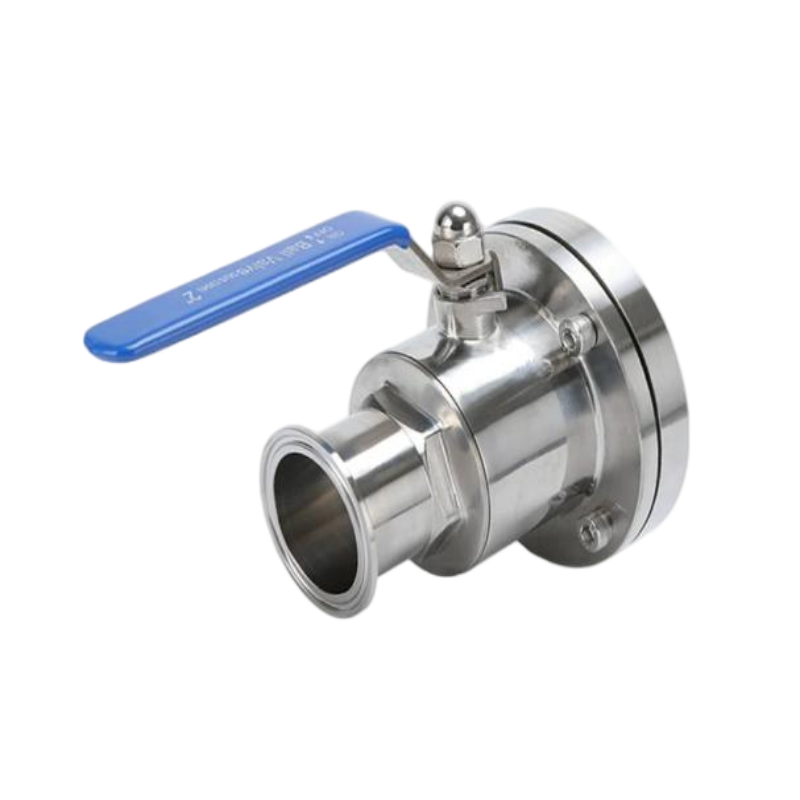
Sanitary Tank Bottom Valve Stainless Steel 316L 1 to 4 Inch
Sanitary Tank Bottom Valve Stainless Steel 316L 1 to 4 Inch Flush Bottom Design
A sanitary tank bottom valve solves one specific problem: how to empty a vessel completely without leaving product behind. Any outlet nozzle on the side or on a dished bottom creates a dead leg below the drain point, and that pocket is where residue collects, where bacteria grow and where cleaning validation quietly fails. A flush bottom valve mounts directly on the tank bottom so the seat sits at the lowest point of the vessel, and the line drains completely with no trapped volume. We build these valves in 316L stainless steel from 1 inch to 4 inch, in manual, pneumatic and actuated versions.
Flush Bottom Geometry and Why It Matters
The critical dimension is not the valve bore, it is the distance between the valve seat and the lowest point of the tank interior. In a conventional arrangement with a side outlet, that distance is the full length of the nozzle, and product sits in it permanently. A flush bottom valve welds onto a short pad or directly onto the tank bottom so the seat face is effectively at the vessel surface. Some designs leave the disc protruding slightly into the tank when open, which is deliberate: it keeps the seat area swept by the product flow and avoids a recess where solids can settle. For tanks handling suspensions or products with pulp and particulates, this geometry is the difference between a line that passes cleaning validation and one that does not.
Seat, Seal and Actuation
Seat material is selected from the product and the cleaning regime rather than from price. PTFE gives the widest chemical resistance and the highest temperature ceiling, EPDM suits steam and hot water sterilisation, and silicone is chosen where the product is sensitive to other elastomers. The valve body is machined from bar or forged stock in 316L with a controlled internal surface finish, and the stem seal is a replaceable cartridge so the valve can be serviced without cutting it out of the tank. Manual operation uses a handwheel or lever, and pneumatic versions use a normally closed or normally open cylinder with a position feedback switch for the control system. Hygienic design principles are followed throughout, with no threaded product contact parts, no crevices and a fully drainable internal cavity.
Key Specifications
| Parameter | Specification |
| Size range | 1 inch to 4 inch |
| Body material | 316L stainless steel, product contact surface finished |
| Seat materials | PTFE, EPDM and silicone available |
| Connections | Clamp, weld and threaded tank mounting options |
| Operation | Manual handwheel or lever, pneumatic cylinder, position feedback switch option |
| Working pressure | Standard hygienic pressure rating, higher on request |
| Working temperature | Dependent on seat material selection |
| Surface finish | Controlled internal finish, fully drainable cavity |
| Cleaning | Suitable for CIP and SIP |
| Documentation | EN 10204 3.1 material certificates, surface finish report, elastomer declaration |
Typical Applications
- Fermentation and bioreactor vessels in dairy and brewing
- Mixing and process tanks in food and beverage production
- Pharmaceutical and cosmetic process vessels
- Storage tanks handling suspensions, pulp and particulate products
- CIP circuits where complete drainage between batches is required
- Any vessel where a side outlet would leave a standing dead leg
Certification and Compliance
Material certificates to EN 10204 3.1 are supplied for body and stem components, together with a surface finish report for the product contact surfaces. Elastomer seats and seals are supported by declarations based on FDA and BfR requirements, which is the documentation set most food and pharmaceutical customers need for their own food contact compliance file. Where the vessel itself is a coded pressure vessel, we supply the matching valve documentation so the tank file and the valve file agree. Third party inspection can be arranged if your project requires it.
Ordering Information
To select the correct valve we need the tank volume, the product and its viscosity, the maximum temperature, the CIP and SIP regime including chemistry, the nozzle size and whether the valve mounts on a pad or directly on the bottom shell. Tell us the operation mode you want, and if it is pneumatic, confirm whether the valve should fail closed or fail open on loss of air. Please also confirm the cleaning requirement, because a valve that is only rinsed needs a different internal geometry from one that must pass a validated SIP cycle.
4. FAQ
Q1. What is the difference between a tank bottom valve and a standard ball valve on a tank outlet?
- A standard ball valve on a side or bottom outlet leaves the outlet nozzle full of product below the seat, and that standing volume is a dead leg that cleaning may not reach. A tank bottom valve is mounted so the seat sits at the vessel surface, and it drains completely. On tanks handling dairy, pharmaceutical or particulate products this is normally the deciding factor, not the valve price.
Q2. Which seat material should I choose?
- PTFE for the widest chemical resistance and the highest temperature range, EPDM where the valve will see frequent steam or hot water sterilisation, and silicone where the product is sensitive to other elastomers. If your CIP chemistry includes a strong solvent or an aggressive caustic, tell us the composition, because the seat is usually the first component to fail and it is also the cheapest to specify correctly at the outset.
Q3. Can the valve be operated automatically?
- Yes. Pneumatic cylinders are available in normally closed and normally open versions, with a position feedback switch that the control system can read. For a tank that is part of an automated CIP sequence this is usually essential, because the drain valve has to open and close on a recipe step rather than on an operator. Tell us the fail safe direction you need, since that determines the cylinder configuration.
Q4. Is the valve suitable for CIP and SIP?
- Yes, provided the correct seat material is selected and the valve is installed with the correct tank penetration. The internal cavity is fully drainable and there are no threaded product contact parts. For SIP duty confirm the maximum sterilisation temperature so we can match the seat and the stem seal, and make sure the valve is included in your cleaning validation coverage test rather than assumed to be clean because the tank passes.
Q5. What size do I need for my tank?
- Size is set by the discharge rate you need, not by the tank volume, but the two are related. A general starting point is that the outlet should empty the vessel in a time that fits your batch cycle without the pump cavitating. Send us the tank volume, the target emptying time and the product viscosity and we will confirm the size. Undersizing the drain is a common mistake that only shows up when production rates rise.
Related Products
-

Tri Clamp Ball Valve
Triclamp ball valve is a type of valve that is widely used in various industries, including food, be...
阅读更多 -

Hygienic Penumatic Butterfly Valve With Proximity Sensor
24V DC NPN Inductive proximity sensor C top controller sanitary hygienic penumatic actuator butterfl...
-

Welded Sanitary Check Valve
Welded sanitary check valve is one of the essential components used in the food processing industry....
-

2 Piece Ball Valve
A 2-piece ball valve is a type of valve that uses a rotating ball with a hole to control the flow of...