


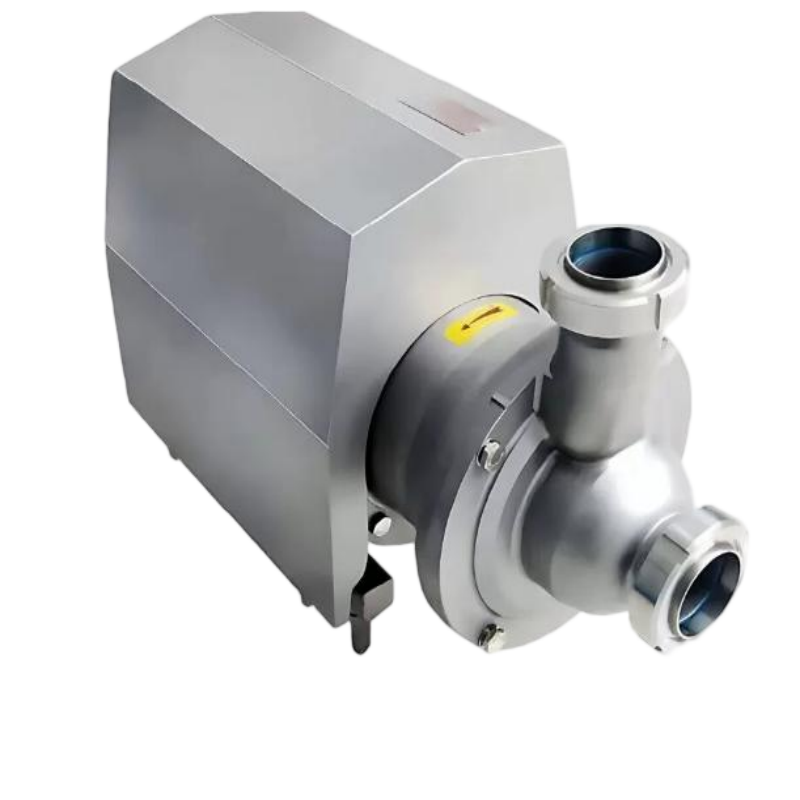
Sanitary Self Priming Centrifugal Pump for CIP Return 316L
Sanitary Self Priming Centrifugal Pump for CIP Return 316L 3A Hygienic Design 1 to 10 HP
A CIP return pump has to do something a standard centrifugal pump cannot. At the end of every clean in place cycle the return line is carrying foamy detergent at low pressure, and a normal centrifugal pump loses prime, cavitates and stops the moment it swallows an air pocket. A self priming centrifugal pump keeps a reservoir of liquid in the casing, so it re-primes itself after each gulp of air and keeps the CIP circuit running. We build these pumps in 316L stainless steel with 3A hygienic design, from 1 to 10 HP, for CIP return, tanker unloading and product recovery duties.
How Self Priming Works
The pump casing is larger than a standard centrifugal volute and is designed to hold liquid after shutdown. On start up, the impeller recirculates that retained liquid through a separating chamber, which pulls air out of the suction line and discharges it with the liquid rather than locking the impeller. Once the suction line is full of liquid the pump behaves like an ordinary centrifugal pump and delivers a smooth flow. This is why a self priming pump can lift from a floor drain or an emptied tank, and why the reservoir volume in the casing matters: a casing that is too small for the suction line volume will still lose prime on a long or high lift. We size the casing against your actual suction line rather than against a nominal model number.
Seal, Impeller and Cleanability
The shaft seal is the component that decides how long the pump survives in CIP service. A single mechanical seal with a sanitary flush is adequate for most beverage and dairy duties. For pharmaceutical work and for products that crystallise or set when they cool, a double mechanical seal with a barrier fluid or a seal-less magnetic drive removes the risk of product entering the seal faces entirely. Impellers are open or semi-open depending on the solids content, and are balanced for the duty rather than for a catalogue figure. All product contact surfaces are 316L with a controlled finish, the casing drains completely through a low point, and there are no horizontal ledges where detergent or product can stand.
Key Specifications
| Parameter | Specification |
| Type | Self priming sanitary centrifugal pump |
| Materials | 316L stainless steel product contact, 3A hygienic design |
| Power range | 1 to 10 HP, larger on request |
| Connections | Sanitary clamp, DIN 11851 or flange as required |
| Impeller | Open or semi open, balanced for the duty |
| Shaft seal | Single mechanical seal with flush, double seal or magnetic drive options |
| Surface finish | Controlled hygienic finish, fully drainable casing |
| Motor | IP55 standard, IP66 and explosion proof on request |
| Control | Variable frequency drive compatible |
| Documentation | EN 10204 3.1 material certificates, test report, elastomer declaration |
Typical Applications
- CIP return duty in dairy, beverage and food plants
- Tanker and road tanker unloading where suction lift is required
- Product recovery from vessels and floor drains
- Foamy products including fermented beverages and detergent solutions
- Pharmaceutical and cosmetic hygienic transfer
- Any duty where the suction line runs empty or contains air
Certification and Compliance
Pumps are supplied with EN 10204 3.1 material certificates for product contact parts, a performance test record and, where fitted, elastomer declarations based on FDA and BfR requirements. The hygienic design follows 3A principles, with fully drainable geometry and no threaded product contact connections. For pharmaceutical projects we can supply additional documentation covering surface finish and the seal arrangement. If your site requires explosion proof equipment, confirm the area classification at enquiry stage because it changes the motor selection and the lead time.
Ordering Information
To select the correct pump we need the flow rate required, the discharge head, the suction lift and the length and diameter of the suction line, the product and its viscosity at pumping temperature, the maximum temperature for CIP, the solids content and particle size if any, and the electrical supply available. If the duty is CIP return, tell us the tank or vessel volume being drained and the CIP cycle time, because that fixes the flow rate more reliably than a nominal pump size. Impeller trims and alternative speeds are available to bring the duty point onto your system curve.
4. FAQ
Q1. Why can’t I use a standard centrifugal pump for CIP return?
- Because the return line carries a mixture of liquid and air, and often foam. A standard centrifugal pump depends on liquid filling the impeller eye, and as soon as an air pocket arrives it loses prime, the flow collapses and the pump runs dry. A self priming pump retains liquid in the casing and separates the air, so it recovers by itself. On most CIP systems a standard pump will not complete a cycle reliably.
Q2. How much suction lift can it handle?
- It depends on the casing volume, the suction line size and the product, but as a working range these pumps handle suction lifts in the region of 4 to 6 metres when correctly sized and primed, with shorter lines giving better results. The limit is set by the physics of air removal rather than by the motor. Send us the suction line length and diameter and we will confirm the achievable lift before you commit to a layout.
Q3. Which mechanical seal should I choose?
- A single mechanical seal with a sanitary flush for general dairy and beverage duty. Specify a double seal with barrier fluid, or a seal-less magnetic drive, when the product crystallises or sets on cooling, when the fluid is aggressive, or when a seal failure would release product into the environment. The seal is the component most likely to define your maintenance interval, so it is worth choosing deliberately rather than by default.
Q4. Is the pump CIP cleanable?
- Yes, and it is designed for it. The casing drains completely at a low point, the product contact surfaces are 316L with a controlled finish, and there are no horizontal ledges or threaded product contact connections. In CIP return service the pump is part of the cleaning circuit by definition. We recommend including the pump in your coverage test rather than assuming it is clean because the tank passes.
Q5. What motor and control do I need?
- Standard supply is IP55, with IP66 or explosion proof available on request. We recommend a variable frequency drive on CIP return duty, because the required flow often varies between the wash and the final rinse steps and a fixed speed pump is then either oversized or starved. If your area is classified, tell us at enquiry stage so the motor is selected correctly from the start.
Related Products
-

Sanitary Stainless Steel Centrifugal Pump
A sanitary stainless steel centrifugal pump is an essential tool in the food, pharmaceutical, and be...
阅读更多 -

CIP Pump
CIP (Clean-in-Place) pumps are an essential component in the food and beverage industry. These pumps...
-

Self Priming Sanitary Pump
A self-priming sanitary pump is a specialized type of pump used in the food, beverage, pharmaceutica...