


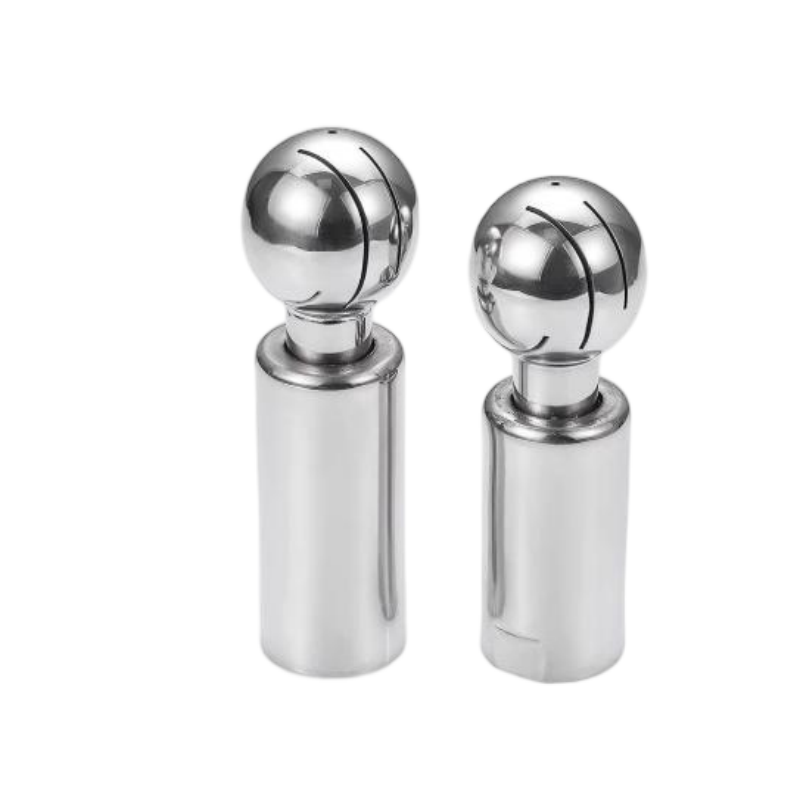
Sanitary CIP Spray Ball Stainless Steel 316L Rotary Type
Sanitary CIP Spray Ball Stainless Steel 316L Rotary Type for Tank Cleaning Coverage
A CIP spray ball is judged on one number that most suppliers never publish: whether it actually hits every square metre of the tank wall at the flow rate and pressure you have available. Coverage depends on the ball geometry, the orifice size, the inlet pressure and the distance from the ball to the far wall, and a ball that is undersized for a tall vessel leaves a dry band that nobody notices until a swab test fails. We supply rotary and static CIP spray balls in 316L stainless steel with published flow and throw data, so the ball can be sized against your tank instead of guessed.
How Coverage Is Actually Achieved
The cleaning action is mechanical, not chemical. Detergent removes soil once it reaches the surface, so the job of the spray ball is to deliver a film of solution to every internal surface at enough impact to lift residue, for long enough to hold the surface wet. Three variables control this. Inlet pressure sets the jet velocity. Flow rate sets how much solution is delivered per unit of time and therefore how long the tank walls stay wet. Throw distance, which is the horizontal reach of the jet, decides whether the far side of a wide tank is reached at all. A tall narrow tank and a short wide tank at the same volume need different balls, which is why volume alone is never enough information to size a spray ball.
Rotary and Static Types
A static spray ball is a fixed sphere with drilled orifices that throws solution in all directions at once. It has no moving parts, so it cannot seize, and its coverage pattern can be predicted accurately from the orifice layout and the supply pressure. A rotary spray ball turns on a fluid bearing driven by the supply flow itself, and its jets sweep the wall in a moving pattern. Rotary balls typically use less water to cover the same surface and reach further, which matters in large vessels, but they depend on adequate flow to rotate and they need a clean supply. For small tanks and for applications where maintenance access is difficult, static is often the safer choice. We supply both, and we will tell you which one your tank geometry actually calls for.
Key Specifications
| Parameter | Specification |
| Materials | 316L stainless steel, other grades on request |
| Types | Rotary and static spray ball |
| Connections | Clamp, threaded and welded pin connections |
| Surface finish | Controlled hygienic finish, fully drainable geometry |
| Operating pressure | Typically 2 to 4 bar, confirmed per application |
| Operating temperature | Up to 95 degrees C standard, higher on request |
| Coverage data | Flow rate and throw distance published for each model |
| Sizing range | Suitable for tanks from 1 to 50 cubic metres |
| Cleaning validation | Coverage test support and documentation on request |
| Documentation | EN 10204 3.1 material certificates, flow and pressure data |
Typical Applications
- Dairy silos, process tanks and milk reception vessels
- Brewery fermenters, bright beer tanks and yeast vessels
- Beverage syrup and blending tanks
- Mixing and process vessels in food production
- Pharmaceutical and cosmetic process tanks
- Tanks handling sauces, dressings and other high solids products
Certification and Compliance
Spray balls are supplied with EN 10204 3.1 material certificates and, for each model, with the flow and throw data your cleaning validation protocol will reference. Product contact surfaces are finished to a controlled hygienic standard and the geometry is fully drainable. Elastomer components, where fitted, are supported by declarations based on FDA and BfR requirements. Where a project requires documented coverage evidence, we support the riboflavin coverage test by providing the spray pattern data and the recommended test procedure, so your validation report is built on measured performance rather than on a supplier claim.
Ordering Information
To size the ball correctly, send us the tank internal diameter, the tank height from the ball position to the far wall, the total surface area to be cleaned, the pump flow and pressure available at the ball, the cleaning solution temperature, and the connection you want on the tank. If you already know the CIP pump curve, send it, because the ball has to be matched to the pump you have rather than to a nominal rating. For tanks with internal fittings such as agitators, baffles or dip pipes, tell us where they are, since obstructions shadow the spray pattern and the ball position may need to change.
4. FAQ
Q1. How do I size a spray ball for my tank?
- By geometry and flow, not by volume. We need the tank diameter, the distance from the ball to the far wall, and the flow and pressure your CIP pump can deliver at the ball. Volume tells you how much cleaning solution you will use, but it does not tell you whether the jet reaches the far side of the vessel. Send those figures and we will recommend a model and confirm the flow it needs to perform as documented.
Q2. What is the difference between rotary and static spray balls?
- A static ball is fixed and sprays in all directions continuously from drilled orifices, with no moving parts. A rotary ball turns on a fluid bearing and sweeps the walls with moving jets, typically using less water and reaching further. Rotary is usually the better choice in large tanks, static in small tanks or where maintenance access is poor. If your supply pressure fluctuates or your detergent is not clean, a static ball is more forgiving.
Q3. How do I prove the coverage is complete?
- With a riboflavin coverage test, which is the method most auditors accept. The tank interior is coated with a riboflavin solution, the CIP cycle is run, and the tank is inspected under ultraviolet light; any remaining fluorescence shows a surface the spray did not reach. We provide the spray pattern data and the recommended procedure so the test can be planned properly, and where the test identifies a shadowed area the answer is usually ball position or a second ball rather than a larger one.
Q4. What connection do I need on the tank?
- Clamp, threaded and welded pin connections are all available. For hygienic service a clamp or a welded pin connection is preferred, because a threaded joint in the tank head is a crevice that is difficult to clean and will be raised in an audit. The connection also affects the installed height of the ball, which changes coverage, so decide the connection before you finalise the ball position.
Q5. At what pressure and flow should the ball operate?
- Most CIP spray balls are designed to work in the region of 2 to 4 bar inlet pressure, and the required flow is stated per model. The point that matters is that both are satisfied simultaneously, because a ball supplied at the correct flow but too low a pressure will produce a weak, drifting pattern. When you send your CIP pump curve we will confirm the operating point against the model we recommend.
Related Products
-

Tri Clamp Bowl Reducer
Tri-Clamp Bowl Reducers are a type of component used in the food and beverage industry. These reduce...
阅读更多 -

Tri Clamp BSP NPT Adapter
The Tri-Clamp BSP/NPT Adapter is a type of fitting that is used to connect a piece of equipment with...
-

Tri Clamp Manifold
A Triclamp manifold is a type of fluid-handling system designed to regulate and control the flow of ...
-

Tri Clamp Hose Adapter
Tri Clamp Hose Adapter is a common term used in the food, beverage, and pharmaceutical industries. I...